What went into it
Background · decisions · deliveryThe context
The underlying systems do very different jobs. An InMoov head needs correct calibration and mechanical limits. A desktop app needs to know whether the robot and its services are available. An assistant needs to know which tools can actually carry out a request. One status indicator cannot answer all three questions.
Physical work and software work are separate
The physical experiments use an InMoov head, servo controls, and ROS 2. A joint control needs predictable bounds and a way to test motion on its own. The desktop console is designed to expose state rather than imply that every part is connected.
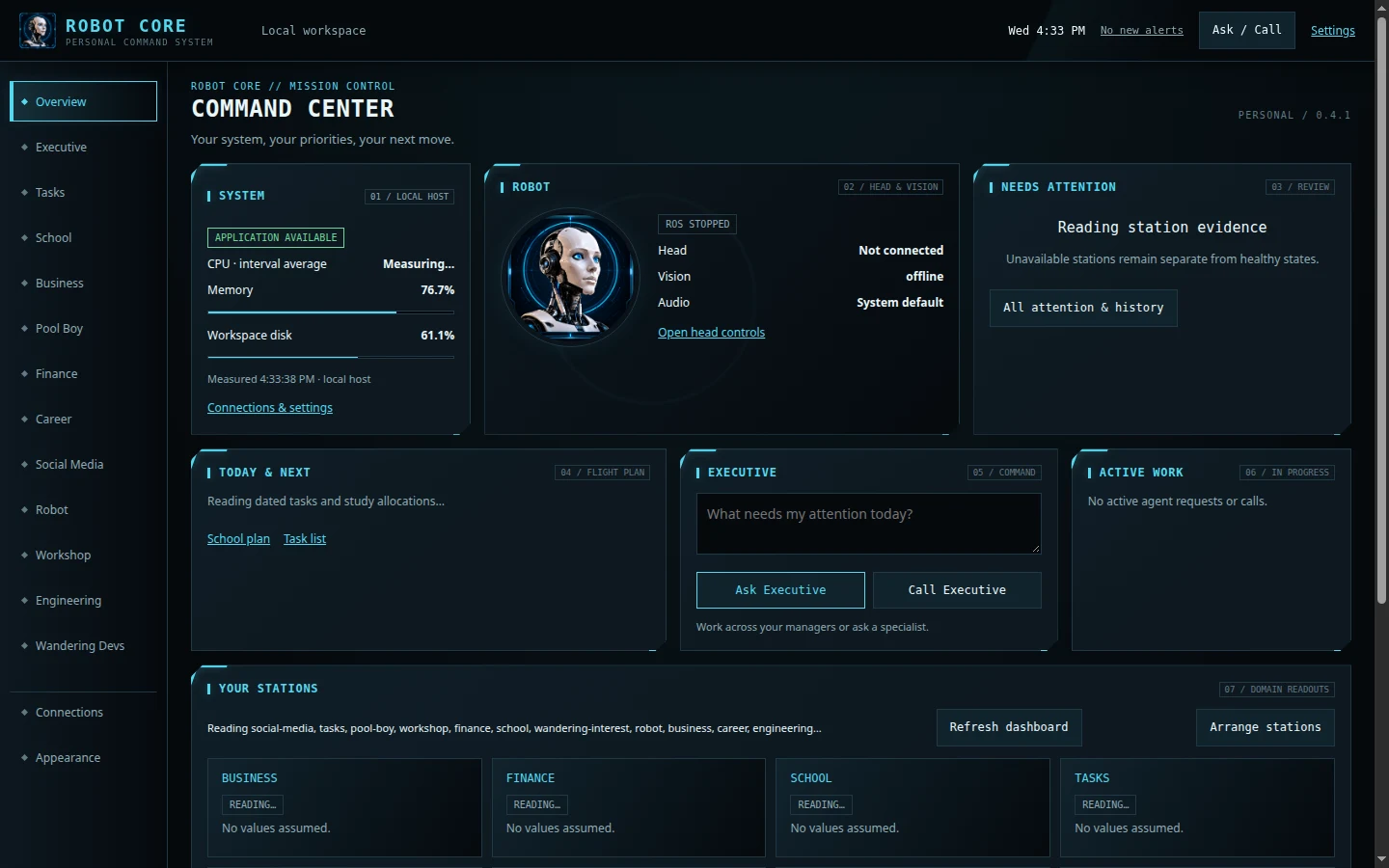
What the screenshot shows
The command deck shows a system panel, a robot panel, tasks and workspace areas, and an assistant console. The capture is from an isolated demo. It’s useful because it shows the separation of states and controls without revealing a private workspace.
What the project is testing
When a request crosses a subsystem boundary, where should approval happen? How do you distinguish a successful handoff from an action that never changed anything? Robot Core is a test bed for those questions, not a claim that every workflow is finished.
 Product case study